


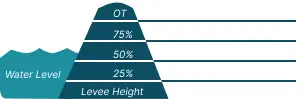
 0 Occurrences
1 Occurrences
1 Occurrences
5 Occurrences
0 Occurrences
1 Occurrences
1 Occurrences
5 Occurrences
 Tulsa-West Tulsa Levee - Levee A and B
 Location
City, County, and State of the levee system. Determined by the
levee alignment location not the leveed area.
Sand Springs, Tulsa County, Oklahoma
System ID
Unique identifier code for the levee system using 10 or 12 numbers
in length.
5805000023
Operation and Maintenance Organization
Entity responsible for day-to-day management of the levee.
Drainge District 12
Floodplain Management
Entities responsible for regulating activities that occur in
areas prone to flooding.
FEMA Region 6
Oversight Organization
Entity responsible for oversight of the levee and ensuring it
is maintained.
USACE - Tulsa District
Last Assesment Date
Last Risk Assessment or Formal Inspection.
7/21/2019
Data Last Updated
Date any of this information for the system has been updated.
9/12/2024
Levee Length
Combine length of all the levee system features including the
embankments, floodwalls, closures where they exist for this
system.
 10.724 Miles
 Average Levee Height
The average height of the levee system. The levee profile viewer
on the mapping window will show the actual levee height values
for the length of the levee if available.
 12 Feet
 Year Levee Constructed Year levee system was fully completed as a flood reduction
project.
 1944
1944 Summary
General text description of the levee system with a
summary of why the levee is there, and the benefits it
provides.
Tulsa and West Tulsa Levees A and B are on the Arkansas River in Tulsa County, Oklahoma. The levees are earth embankments averaging 15 feet tall and each being about five miles long and they are connected by concrete floodwalls built over a box culvert floodway structure that allows a major road and a railway to cross the mouth of Bigheart Creek. The levees were constructed by the U.S. Army Corps of Engineers and after completion in 1944 ownership was transferred to Tulsa County Drainage District No. 12 for continued operations, maintenance, repair, rehabilitation, and replacement actions.
There are approximately 6,275 people who live and work behind this levee. Without the levee, it is estimated that some 3,072 residential and commercial structures valued up to $1.13 billion dollars could be flooded. Additional environmental consequences could result if Superfund site behind levee is flooded. Loss of life is possible if the levee were to fail or overtop during a flood.
The levees have a history of poor performance. During the 1984 record rainfall event in Tulsa, Bigheart and Harlow Creeks overtopped levees causing extensive erosion and foundation failure of floodwalls. Dozens of residential structures were flooded and many were demolished. The 05OCT1986 flood of record with a 307,000 CFS flow on the Arkansas River loaded levees to about 80% of their total height and breaches were barely contained by flood fighting efforts. Significant repairs were made after both events but concerns remain with aging culverts, plugged toe drains and relief wells, and antiquated pumping stations that are all now more than 70 years old.
Performance & Condition
General text description of the historical and
anticipated performance of the levee, the people and
property benefitting from the levee and who may be at
risk of flooding, and actions to address areas of
concern.
Tulsa West Tulsa Levees A and B are considered to be High Risk as determined by a risk assessment finalized in December 2016. This is because of: 1.) levee overtopping is highly likely; 2.) levee erosion and breach are expected during overtopping; and 3.) rapid flooding will cause extensive property destruction and life loss.
Flooding Hazard
Historic Loading by Percentage of Height
 Representative loading associated with historical
flood information as a percentage of the levee height
or overtopping.
Representative loading associated with historical
flood information as a percentage of the levee height
or overtopping.
Representative loading associated with historical
flood information as a percentage of the levee height
or overtopping.
0 Occurrences
1 Occurrences
1 Occurrences
5 Occurrences