


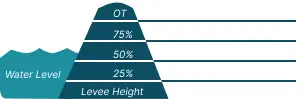
 0 Occurrences 16 Occurrences 18 Occurrences 19 Occurrences
  Middle Creek left bank - Unit 1 south
 Location
City, County, and State of the levee system. Determined by the levee alignment location not the leveed area.
Upper Lake, Lake County, California
System ID
Unique identifier code for the levee system using 10 or 12 numbers in length.
5205000275
Operation and Maintenance Organization
Entity responsible for day-to-day management of the levee.
Central Valley Flood Protection BoardLake County Watershed Protection DistrictCA Department of Water ResourcesSutter Maintenance Yard - DWRCentral Valley Flood Protection BoardCA Department of Water Resources
Floodplain Management
Entities responsible for regulating activities that occur in areas prone to flooding.
FEMA Region 9
Oversight Organization
Entity responsible for oversight of the levee and ensuring it is maintained.
USACE - Sacramento District
Last Assesment Date Last Risk Assessment or Formal Inspection.
6/23/2017
Levee Length
Combine length of all the levee system features including the embankments, floodwalls, closures where they exist for this system.
 3.508 Miles
 Average Levee Height
The average height of the levee system. The levee profile viewer on the mapping window will show the actual levee height values for the length of the levee if available.
 9 Feet
 Year Levee Constructed Year levee system was fully completed as a flood reduction project.
 No Data
 Summary
General text description of the levee system with a summary of why the levee is there, and the benefits it provides.
Middle Creek runs north to south through the community of Upper Lake before feeding into the north end of Clear Lake. Clover Creek runs through Upper Lake and joins Middle Creek about one thousand feet south of Highway 20. Middle Creek and its tributaries have a history of flooding, so levees were built to lower the risk of flooding in nearby areas.
Middle Creek left bank – Unit 1 South is a levee system made up of two levees. Tying into Highway 20 at the upstream end and continuing along the east bank of Middle Creek for about 1 mile is the levee formally known as Middle Creek – Unit 1, left bank below Clover Creek. On the north bank of Alley Creek connecting to the Unit 1 North levee and running about 1.5 miles east is the levee formally known as Middle Creek – Unit 4, Alley Creek. Combined these two levee segments make up the system Middle Creek left bank – Unit 1 South. These levees were constructed between 1958 and 1959, and were improved by USACE in 1966. The total length of the system is about 3.5 miles. The leveed area (flood risk area) for this system is about 2.4 square miles. The land use in the leveed area for this system is predominantly agricultural with some residential land.
Performance & Condition
General text description of the historical and anticipated performance of the levee, the people and property benefitting from the levee and who may be at risk of flooding, and actions to address areas of concern.
This levee system has had poor performance during past floods and poor performance is expected in the future. In multiple flood events, water has nearly risen over the top of the levee. During the 1998 flood, multiple locations of through seepage (water flowing through the levee soil) were observed. Two slope stability failures (landslides) occurred in the levee slope, and erosion (levee soil washing away) was seen at several sites during this flood. The slope stability failures were repaired under emergency conditions. There are also concerns with large trees growing in the levee slope and animal burrows that may cause future seepage problems.
While the levee is not expected to perform well during a flood, the consequences of a levee failure are relatively low and this system is considered low risk. If the levee were to fail, flood water depths near the population center would be low, there is a relatively low population at risk, and flooding would be predicted days in advance, allowing early warning for people to evacuate. About 170 people live or work inside the leveed area and they are, in general, moderately aware of the levee system and the role it plays in lowering flood risk. In the event of a breach (levee breaking open), the population at risk would see flood water depths up to 6 ft; however, most of the population lives in areas where flood water depths would be less than 2 feet.
Flooding Hazard
Historic Loading by Percentage of Height
 Representative loading associated with historical flood information as a percentage of the levee height or overtopping.
Representative loading associated with historical flood information as a percentage of the levee height or overtopping.
0 Occurrences 16 Occurrences 18 Occurrences 19 Occurrences