


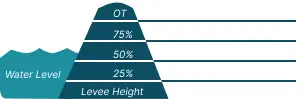
 0 Occurrences 0 Occurrences 0 Occurrences 2 Occurrences
  Louisville Metro Levee System
 Location
City, County, and State of the levee system. Determined by the levee alignment location not the leveed area.
Louisville/Jefferson County metro government (balance), Jefferson County, Kentucky
System ID
Unique identifier code for the levee system using 10 or 12 numbers in length.
3905000028
Operation and Maintenance Organization
Entity responsible for day-to-day management of the levee.
City of Louisville
Floodplain Management
Entities responsible for regulating activities that occur in areas prone to flooding.
FEMA Region 4
Oversight Organization
Entity responsible for oversight of the levee and ensuring it is maintained.
USACE - Louisville District
Last Assesment Date Last Risk Assessment or Formal Inspection.
5/5/2020
Data Last Updated Date any of this information for the system has been updated.
7/18/2025
Levee Length
Combine length of all the levee system features including the embankments, floodwalls, closures where they exist for this system.
 25.967 Miles
 Average Levee Height
The average height of the levee system. The levee profile viewer on the mapping window will show the actual levee height values for the length of the levee if available.
 35 Feet
 Year Levee Constructed Year levee system was fully completed as a flood reduction project.
 1954
1954 Summary
General text description of the levee system with a summary of why the levee is there, and the benefits it provides.
The Louisville-Metro Levee System is federally authorized and constructed under the Flood Control Act approved 28 June 1938, and non-federally operated and maintained. It is located in Jefferson and Bullitt Counties, Kentucky, along the left bank of the Ohio River; extending from river mile 602.0 to 628.6. The Louisville-Metro Levee provides flood risk reduction to the City of Louisville and portions of Jefferson and Bullitt Counties. As of the 2010 census, the total population of Jefferson County was 741,096.
The levee system has a total length of near 26 miles and consists of approximately 21.0 miles of earthen embankment, 4.20 miles of concrete wall, 15 pump stations (housing 73 pumps), 152 gates, 77 closures, and other necessary appurtenances. The leveed area is estimated at approximately 49,000 acres and reduces risk against Ohio River floods equal to the maximum of record, elevation 460.15 feet (NAVD88) in January 1937, with a freeboard of three feet (providing risk reduction to an estimated 8,000 year return event).
Construction on the Louisville Reach began in March 1947 and was completed in 1956. It was transferred to local interests for operation and maintenance in two parts, with the first portion transferred in January 1953 and the second portion transferred in July 1954. Design top of levee elevations along this reach vary from 458.3 to 463.7 feet (NAVD88).
The Southwestern Jefferson Reach (which extends into a portion of Bullitt County) was authorized by the Flood Control Act of August 1968. Construction of the Southwest Jefferson Reach began in October 1973 and was completed in 1989. Design top of levee elevations vary from 457.2 to 459.0 feet (NAVD88). Upon completion of the Southwest Jefferson Reach, approximately 4.7 miles of levee embankment and a pump station located along the Mill Creek Cutoff were abandoned (Section E, Louisville). This portion of levee is obsolete and is no longer required to be maintained.
Performance & Condition
General text description of the historical and anticipated performance of the levee, the people and property benefitting from the levee and who may be at risk of flooding, and actions to address areas of concern.
The Louisville Metro Levee System contain two reaches, the Louisville reach and the Southwest Jefferson reach. The System reduces the flood damage risk for approximately 201,000 people and roughly 41,900 acres of commercial, industrial, and farmland with roughly 89,800 buildings and an improved property value of about $20.0 B. The leveed area is densely populated with a population at risk of up to 79,750 and average flood depths range from 2 to 20 feet for overtopping with a levee breach.
The 2024 Formal Inspection verified the levee sponsor's commitment to maintaining the integrity of the levee, which contributes to past performance success and expected good performance for future, more significant events.
Flooding Hazard
Historic Loading by Percentage of Height
 Representative loading associated with historical flood information as a percentage of the levee height or overtopping.
Representative loading associated with historical flood information as a percentage of the levee height or overtopping.
0 Occurrences 0 Occurrences 0 Occurrences 2 Occurrences